NewsArticle
Professional secrecy and AI: what the French bar council says, and how to pseudonymise
Professional secrecy is the first obstacle to using AI in law firms. What the French bar council says today, which AIs are concerned, and how to pseudonymise your data in practice.
Today, no one denies that AI has a huge capacity to transform the work of lawyers, especially if it can be given as much information as possible.
What holds things back is professional secrecy. It is what stops lawyers from using AI to the full today. And it is one of the first topics that comes up in almost every one of our meetings.
There is no simple answer, and there are arguments on both sides.
Why put more locks on AI than on the tools we already use? Most firms have long entrusted their emails to Outlook and their files to SharePoint.
But the Conseil national des barreaux (CNB), France’s national bar council, also points out that every request sent to a generative AI passes data to the company that runs it, which keeps it, processes it and sometimes uses it to train its models.
We will not settle the question here. But we can lay the groundwork: what secrecy is, what the CNB says today, which AIs are concerned, and how to pseudonymise.
What exactly is professional secrecy?
A French lawyer’s professional secrecy is set out in article 66-5 of the law of 31 December 1971. In every field, advice and litigation alike, it covers advice given to the client, correspondence with the client and between lawyers (except letters marked “officielle”), meeting notes and every document in the file.
Article 2 of the national internal rules of the profession (RIN), published by the CNB, adds three points:
- The lawyer is the client’s necessary confidant. The secret does not belong to the lawyer: as the CNB puts it in its AI guide, the lawyer is its guarantor and keeper.
- Secrecy is a matter of public policy, general, absolute and unlimited in time. It gives way in only two cases: the lawyer’s own defence before a court, and cases where the law requires or allows disclosure.
- It covers every medium, paper or electronic, and extends to the names of clients and the lawyer’s diary.
Breaching it is a criminal offence: article 226-13 of the French Criminal Code punishes the disclosure of secret information with one year’s imprisonment and a €15,000 fine, on top of disciplinary sanctions.
And it goes further than the GDPR. The GDPR protects the data of individuals. Secrecy also covers client companies, the strategy of a case, or a trade secret entrusted by the client. Removing people’s names is therefore not always enough.
What about in-house legal teams?
In-house lawyers are not bound by the professional secrecy of French avocats. Law no. 2026-122 of 23 February 2026 gives their legal advice a form of confidentiality, but under conditions, excluding criminal and tax matters, and from 1 February 2027 at the latest. It is not a secrecy comparable to that of avocats.
For an in-house team using AI, the issue is mainly twofold. First, the advice of its outside lawyers, which is covered by secrecy: the CNB even recommends that lawyers warn their clients of the risk of putting it into an AI that does not guarantee secrecy. Second, the company’s own information, trade secrets and personal data first.
What the CNB says today
The reference today is the CNB’s guide « La déontologie et l’intelligence artificielle » (ethics and artificial intelligence), adopted at its general assembly of 12 and 13 March 2026 (1st edition, April 2026). It builds on a first guide from September 2024. As a first edition, its position may still change.
In short:
- The principle: lawyers must never share data about their cases or clients with a generative AI.
- The data concerned: names, addresses, phone numbers, financial or strategic information, and any detail that could identify a person or a company. Case files too.
- The solution: pseudonymisation or anonymisation of the data. The guide asks lawyers to do it systematically, before any use of a generative AI tool, and to limit context to what is strictly necessary.
- The limits: pseudonymisation does not work for every task, for example live minutes of a client meeting. And identification by cross-referencing is a real risk: an amount, the internal name of a project or a way of drafting a contract can be enough to recognise a client.
- The tools: the CNB recommends the legal AIs of legaltechs and legal publishers, and looks at hosting (France, or failing that the European Union) and the nationality of the host. Not reusing data to train models is a prerequisite, but the guide notes that this is generally neither provable nor verifiable.
- The client: it is for the lawyer to decide whether to inform the client. The lawyer must do so if the client asks, and must obtain consent if the client’s data is used to train an in-house AI. The CNB even proposes a standard clause for fee agreements.
The strongest point, to my mind, is in the part on sovereignty: according to the guide, only two things really remove the risk. Pseudonymising or anonymising data before sending it, or installing the AI model on the firm’s own servers.
Which AIs are concerned?
All of them. The CNB’s guide asks lawyers to pseudonymise before any use of a generative AI tool, with no exception for paid or legal offerings. What changes from one category to another is the level of risk and what needs checking.
| Category | Examples | What to check |
|---|---|---|
| Free consumer AI | Free versions of ChatGPT, Claude, Gemini, Le Chat | To be used with the greatest caution according to the CNB. Data may be used to train models: check whether you can opt out |
| Business and enterprise plans | Enterprise versions of ChatGPT and Claude, Microsoft 365 Copilot, Le Chat Enterprise | Contractual commitment not to train on your data, hosting location, nationality of the host, how long requests are kept |
| Legal AI | Tools from legaltechs and legal publishers | Recommended by the CNB for reliable sources. The same data questions apply: the CNB offers a self-assessment grid |
| AI installed in-house | Open-source model (Llama, Mistral) on the firm’s servers | According to the CNB, the only option that removes the risk, alongside prior pseudonymisation. Requires real infrastructure |
Terms change often, from one offering to another and from one year to the next. Before using a tool on client files, read its current terms.
Anonymise or pseudonymise: what is the difference?
The two words are often mixed up. They do not mean the same thing.
| Pseudonymise | Anonymise | |
|---|---|---|
| The principle | Replace names, companies and addresses with aliases (PERSON_1, COMPANY_A) | Make any identification impossible, in practice and for good |
| Reversible? | Yes, with a mapping table kept separately | No |
| Under the GDPR | The data remains personal data | It falls outside the GDPR |
| With an AI | The real names go back into the answer: useful for drafting, summarising, reviewing a document | The answer stays anonymous: useful for analysis, less so for producing the final document |
| The limit | Re-identification by cross-referencing (amount, project name, context) | Part of the information is lost |
On a case, you almost always pseudonymise: you need the real names back at the end. Anonymisation is more for datasets, statistics, or examples you want to share.
How to pseudonymise in practice
The principle is simple: the real names stay with you, and the AI only sees aliases.
- Spot what identifies: names of people and companies, addresses, phone numbers, emails, numbers (company number, IBAN, case number), and details that give a client away, such as an amount or a project’s internal name.
- Replace them with aliases, always the same across the whole case: Marie Durand becomes PERSON_1 everywhere, so the AI can follow the reasoning.
- Generalise what is still too precise: the city rather than the address, the year rather than the date.
- Keep the mapping table in-house. It never goes to the AI provider.
- Send the pseudonymised text to the chosen AI.
- Restore the real names in the answer, using the table.
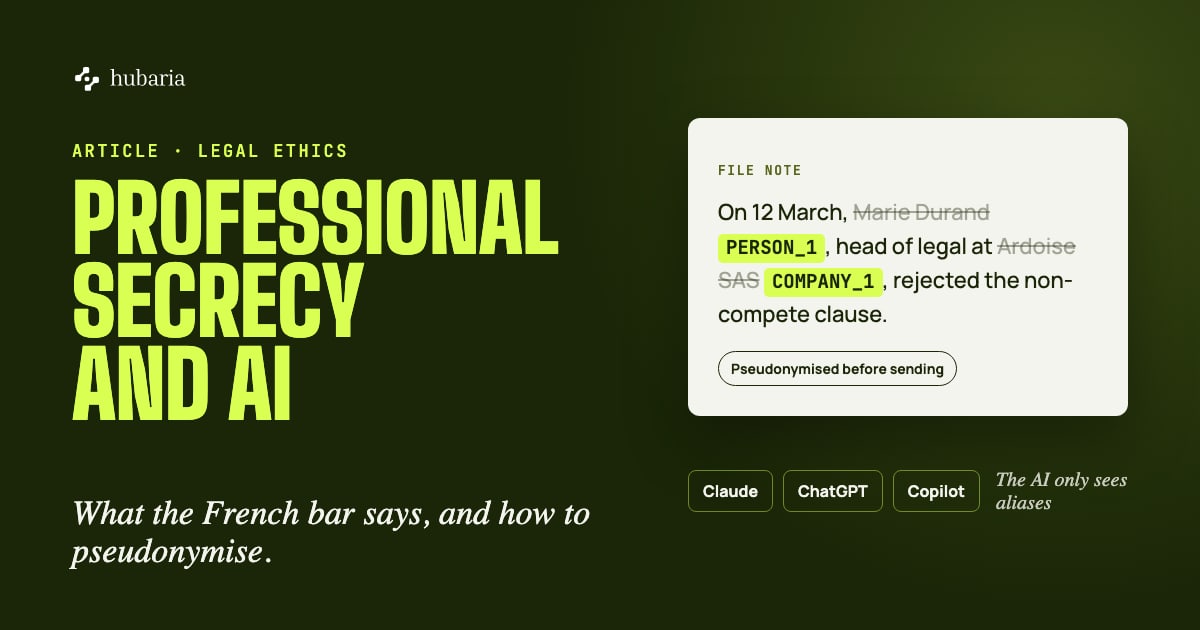
An example. “On 12 March, Marie Durand, head of legal at Ardoise SAS, rejected the non-compete clause” becomes “On 12 March, PERSON_1, head of legal at COMPANY_1, rejected the non-compete clause”. The AI can work on the substance without knowing who it is about.
The mapping table never leaves the firm: it is what puts the real names back into the answer.
By hand, this works for a paragraph. For a whole case, you need a tool that spots the names, keeps the same aliases from one document to the next and keeps the table up to date.
What we offer
If the CNB asks lawyers to pseudonymise before any use of generative AI, then to my mind every AI that works on client files should pseudonymise by default. Without the lawyer having to think about it.
In practice, that is rarely the case. Pseudonymising a paragraph by hand is fine. A whole case, with its emails, documents and meeting notes, is not manageable.
That is why we put it at the heart of Hubaria’s Datahub: sensitive information is pseudonymised before it goes to the chosen AI, and the data stays hosted in France or in the client’s own infrastructure.
How we got here is told in Hubaria’s origins.
It does not solve everything. The risk of cross-referencing remains, and some tasks are still hard to pseudonymise. But it changes the question: you no longer have to ask yourself “am I allowed to put this into the AI?” with every request.
Frequently asked questions
Can a French lawyer use ChatGPT?
Yes, the Conseil national des barreaux (CNB) does not ban generative AI. But in its April 2026 guide, it asks lawyers never to send it data covered by professional secrecy, and to pseudonymise or anonymise data systematically before using it.
What does the CNB say about AI and professional secrecy?
Its guide on ethics and artificial intelligence, adopted in March 2026, forbids sharing data about cases or clients with a generative AI. The solution it gives is to pseudonymise or anonymise the data beforehand.
Is pseudonymisation enough to protect professional secrecy?
It greatly reduces the risk without removing it. A case can still be recognised by cross-referencing (an amount, a project name), and some tasks, such as live minutes of a client meeting, cannot be pseudonymised.
What is the difference between anonymisation and pseudonymisation?
Pseudonymisation replaces names with aliases and can be reversed with a mapping table kept separately: the data remains personal data under the GDPR. Anonymisation makes any identification impossible, irreversibly.
Does an AI hosted in France or an enterprise plan remove the need to pseudonymise?
According to the CNB, no. Commitments not to reuse data are generally neither provable nor verifiable. Only prior pseudonymisation, or installing the model on the firm's own servers, removes the risk.
Should a lawyer tell the client that AI is used?
According to the CNB, it is for the lawyer to decide, depending on the case and the relationship. The lawyer must do so if the client asks, and must obtain consent if the client's data is used to train an in-house AI.
Sources
- Law no. 71-1130 of 31 December 1971, article 66-5 (Légifrance, in force since 30 March 2011)
- National internal rules of the legal profession (RIN), article 2 (CNB website)
- French Criminal Code, article 226-13 (Légifrance)
- CNB, guide « La déontologie et l'intelligence artificielle », 1st edition, April 2026: pages 14 to 19 (secrecy, pseudonymisation), 25 to 27 (choosing tools, sovereignty) and 34 to 36 (informing the client)
- CNB, « Le CNB adopte un guide sur la déontologie et l'intelligence artificielle », 17 March 2026
- Dechert, analysis of Law no. 2026-122 of 23 February 2026 on the confidentiality of in-house lawyers' advice
- European Data Protection Board, adoption of guidelines 01/2025 on pseudonymisation
- GDPR, article 4(5) (definition of pseudonymisation)